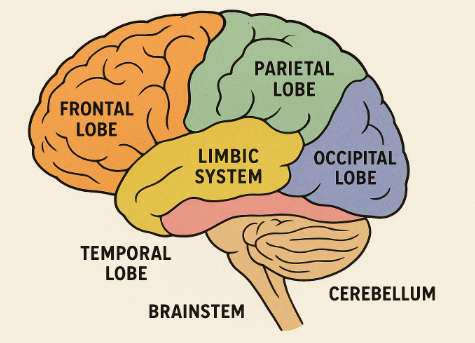
Table of Contents
Far away, inside every person, there exists a magical city—Brain-City. This city never sleeps, never shuts down, and never takes a holiday. Its citizens, buildings, and messengers work together every second to keep life going.
🧠 The Human Brain: The City Within Us
Hidden inside our skull lies the most fascinating organ in existence—the brain, a living universe of thoughts, emotions, and control. It is often called the “command center” of the body, but it’s much more than that. Imagine it as a bustling city—with mayors making decisions, post offices sorting messages, fire alarms sounding warnings, artists painting dreams, and power plants keeping everything alive.
Every feeling you experience, every decision you make, every memory you cherish, and even the way you breathe or sleep is orchestrated by this extraordinary city of neurons, hormones, and signals. From the frontal lobe that plans your future, to the amygdala that sparks your fears, to the hypothalamus that balances hunger, sleep, and hormones, each part plays its own unique role in keeping you alive and human.
In this blog, we’ll step inside Brain-City, exploring its neighborhoods, messengers, and the daily drama that keeps life moving—told in a way that feels like a story rather than a science lecture.
🌍 The Two Sides of the City: Left vs Right Brain
The brain has two hemispheres, like two halves of a city divided by a river, but connected by a big bridge called the corpus callosum.
- Left Brain City → logical side: accountants, planners, scientists, language experts. It loves numbers, analysis, words, order, and details.
- Right Brain City → artistic side: painters, musicians, dreamers, storytellers. It handles creativity, imagination, music, art, emotions, and big-picture thinking.
💡 They constantly send messages across the “bridge,” so logic and creativity work together.
🏛️ The City Districts (Brain Parts)
1. The Downtown (Frontal Lobe)
This is where the “Mayor’s office” is. It makes decisions, plans the future, controls emotions, and manages speech. When you decide whether to study or scroll Instagram, this office is debating 🗣️.
2. The Map District (Parietal Lobe)
This area is like the city’s survey department—tracking touch, space, temperature, and pain. If you close your eyes and still touch your nose, thank this district.
3. The Arts District (Temporal Lobe)
This place is filled with music halls, libraries, and memory museums. It helps you recognize songs, remember your grandmother’s face, and understand language. 🎶📚
4. The Cinema Hall (Occipital Lobe)
All the movies of your life are projected here—it’s in charge of vision. Every time you see a flower or a rainbow, the occipital lobe lights up like a theater screen 🎥🌈.
⚙️ The Operations Hub
5. Cerebellum (Quality Control Office)
It makes sure movements are smooth and balanced. It’s like the city’s traffic controller—coordinating dance moves, cycling, or even walking without wobbling 🚲💃.
6. Brainstem (Power Plant)
Hidden underground, it powers basic life support: heartbeat, breathing, swallowing. It’s always working, like electricity running in the background ⚡.
❤️ The Emotional Center
7. Limbic System (Heart of the City)
This is where feelings live.
- Amygdala → the fire alarm 🚨, triggering fear or anger.
- Hippocampus → the historian 📜, storing memories and lessons.
- Hypothalamus → the thermostat & hunger controller 🌡️🍔, balancing hormones, thirst, and sleep.
- Thalamus → the post office 📮, routing all sensory messages to the right address.
8. Basal Ganglia (Habit Street)
The place of routines and habits—it decides if you bite your nails, go for a morning jog, or binge-watch Netflix 📺.
📡 The City’s Communication System
Imagine the brain-city has billions of citizens called neurons.
- Each neuron is like a person with a phone 📞.
- They don’t shout across the street; instead, they send tiny electrical sparks (like text messages) down their “wires” (axons).
- At the end, the message hops across a tiny gap (synapse) using neurotransmitters—these are like WhatsApp emojis that carry the tone of the message.
👉 Dopamine is like a “reward sticker” 🎁,
👉 Serotonin is the “happy emoji” 😊,
👉 Acetylcholine is a “memory note” 📝,
👉 GABA is the “calm-down signal” 😌.
This way, billions of conversations keep the city alive every second.
💌 The Hormone Postal Service
Now, hormones are like official letters sent by the city government. Instead of texting quickly like neurons, they send slower, longer-lasting memos through the bloodstream.
The Hypothalamus (city’s Chief Minister) works with the Pituitary Gland (Postmaster General) to control the whole endocrine postal system:
- Adrenaline (from adrenal glands) → emergency siren 🚨 when danger comes (fight, flight, freeze).
- Cortisol → stress mail 📨, keeps energy ready in tough times.
- Dopamine → reward coupon 🎟️, makes you repeat what feels good.
- Serotonin → mood postcard 🌞, tells you if you feel calm or sad.
- Melatonin → sleep invitation 🌙, sent out when night falls.
- Oxytocin → love letter 💌, bonds you to friends, family, pets.
- Insulin → food balance sheet 📊, manages sugar energy.
👀 The City’s Senses (Incoming Signals)
Imagine five busy city gates where messages keep pouring in:
- Eyes (Occipital Cinema Hall) → visuals become movies in your head. 🎥
- Ears (Temporal Music Hall) → sound waves become songs, voices. 🎶
- Skin (Parietal Survey Office) → touch, pain, warmth are filed as reports. ✋🔥
- Nose (Olfactory Station) → smells trigger memory letters directly to the limbic system (ever smelled food and remembered childhood? 🍲).
- Tongue (Taste Bureau) → sweet, salty, bitter, spicy—food reviews delivered 🍭🍋.
All these messages go to the Thalamus Post Office, which sorts and delivers them to the right districts.
🌅 Morning in Brain-City
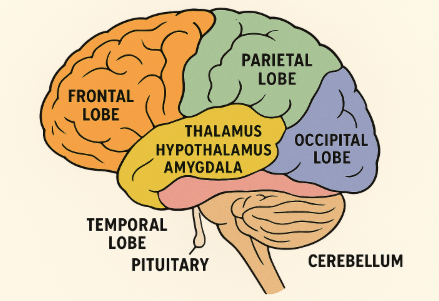
The day begins when the Chief Minister Hypothalamus whispers to the Postmaster Pituitary:
“Send out a Cortisol Letter! Wake everyone up!”
The pituitary quickly dispatches hormones through the city’s bloodstream. As the letters arrive, workers across the city stretch, yawn, and prepare for the new day.
The Mayor Frontal Lobe calls a meeting:
“Today’s plan—finish that assignment, call a friend, maybe hit the gym.”
The Right Brain Artists smile, sketching ideas and dreams, while the Left Brain Accountants double-check details and deadlines.
☕ The Coffee Break
As you sip your morning coffee, the Reward Officer Dopamine rushes in with colorful stickers:
“Good job! You earned this energy!”
The city feels cheerful, thanks to a little help from Serotonin the Mood Manager, who keeps things bright and balanced.
⚡ The Sudden Alarm
But suddenly—BANG! A loud noise echoes.
The Amygdala Fire Alarm screams: “Danger!” 🚨
At once, the Adrenaline Police flood the streets, making the heart beat faster, lungs breathe quicker, and muscles prepare to run.
The Cerebellum Traffic Controller reroutes movement, keeping balance.
The Brainstem Power Plant works overtime, ensuring heartbeat and breathing don’t fail under pressure.
Fortunately, the sound was just a book falling. The Mayor Frontal Lobe sighs: “False alarm, back to work.”
📮 The City Post Office
Throughout the day, the Thalamus Post Office never rests.
- Letters from the Eye Gates become movies in the Occipital Cinema Hall.
- Sound messages from the Ear Gates play in the Temporal Music Hall.
- Touch reports from the Skin Gate are filed in the Parietal Survey Office.
- Delicious smells and tastes arrive at the Nose Station and Taste Bureau, often sparking childhood memories stored by the Hippocampus Historian.
Every sense is carefully routed, sorted, and delivered—no letter ever gets lost.
🤗 Evening Glow
Later, you meet a friend. The Oxytocin Love Letters spread across Brain-City, warming every corner. The Right Brain Artists sing songs of joy, while the Left Brain Accountants write neat records of the memory.
As the sun sets, the Hypothalamus Chief Minister sends out new orders:
“Release Melatonin Invitations. Tell everyone it’s time for rest.”
Slowly, the lights of Brain-City dim. Neurons whisper softly, signals slow, and the great city drifts into peaceful sleep. 🌙✨
🌟 Moral of the Story
Brain-City is alive within you. Its mayors, postmasters, alarms, historians, artists, and messengers never stop working—keeping you safe, balanced, creative, and alive. Every thought, hug, tear, laugh, and dream is the result of this bustling, wondrous city.
🧠 What Happens in a Brain Injury?
Think of the brain as Brain-City we talked about earlier. When injury strikes (from trauma, stroke, or lack of oxygen), some of the “districts” can’t do their jobs properly.
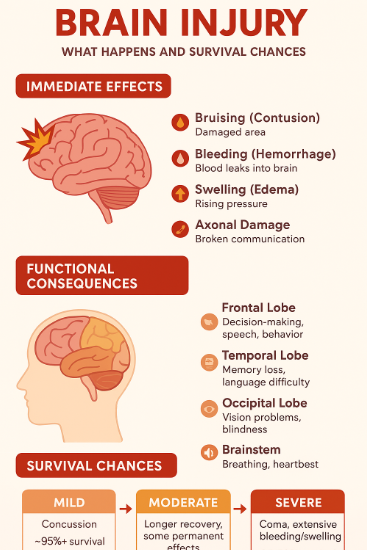
Immediate Effects
- Bruising (Contusion) → like a part of the city getting damaged; neurons in that area may die.
- Bleeding (Hemorrhage) → blood leaks into areas where it doesn’t belong, pressing on tissues.
- Swelling (Edema) → Brain swells inside the skull (which is a hard box), so pressure rises dangerously.
- Axonal Damage → the “phone wires” between neurons snap, cutting communication.
Functional Consequences
- Frontal lobe hit → decision-making, speech, behavior issues.
- Temporal lobe hit → memory loss, difficulty understanding language.
- Occipital lobe hit → vision problems or blindness.
- Cerebellum hit → loss of balance/coordination.
- Brainstem hit → breathing, heartbeat, survival functions threatened.
📊 General Stats (approximate, can vary by study)
- Mild brain injury (concussion): ~95%+ survival, though some get post-concussion symptoms.
- Moderate brain injury: survival 60–80%, but many face disabilities.
- Severe brain injury: survival can be 25–50% depending on rapid care; often long-term dependence.
- Coma > 6 months: very low chance of full recovery, though exceptions exist.
❤️ Survival Chances
Survival isn’t one-size-fits-all—it depends on:
- Severity
- Mild (Concussion) → Most people recover fully.
- Moderate → Longer recovery, some permanent effects possible.
- Severe (coma, extensive bleeding/swelling) → Higher risk of disability or death.
- Location
- Injury to the brainstem is most dangerous (since it controls breathing, heartbeat).
- Injury in “higher” brain areas (like frontal/temporal lobes) can be survived, but may cause long-term changes in personality, memory, or motor skills.
- Time to Treatment
- The “Golden Hour” matters: faster surgery, oxygen supply, and pressure control = higher survival.
- Age & Health
- Younger, healthier people generally heal better. Older age or pre-existing conditions can reduce survival chances.
🌱 Recovery Possibilities
The brain is amazingly plastic (it rewires itself). With rehab (physiotherapy, speech therapy, occupational therapy), people can regain skills—even if slowly. Sometimes other brain regions take over lost functions.
👉 So in short: brain injury doesn’t always mean the end, but survival and recovery depend on how bad, where, and how quickly it’s treated.
Read our blogs here.
External reference link.