Table of Contents
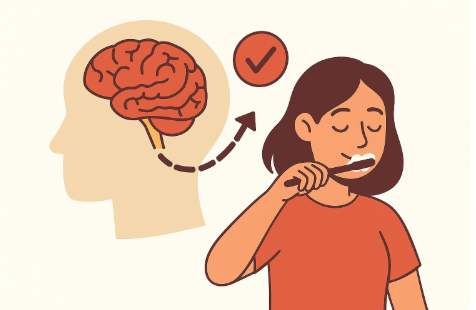
Ever wondered why you can tie your shoelaces, brush your teeth, or unlock your phone without even thinking? That’s your brain’s amazing ability to turn repeated actions into automatic habits. Habits are the brain’s way of saving energy — like putting life on “autopilot” for the small stuff, so you can focus on bigger challenges.
But here’s the twist: while habits make life easier, they can also trap us in routines we don’t always enjoy. Why does the brain create habits so quickly? And why does it sometimes get bored of the very routines it once built? Let’s dive into the fascinating science of how habits form — and why some people love routine while others crave constant change.
🧠 How the Brain Develops Habits (Simple Explanation)
1. It All Starts with a Trigger (Cue)
Something reminds your brain to act.
- Example: You wake up and see your toothbrush → brain says “time to brush.”
2. Then Comes the Action (Routine)
You do the behavior again and again.
- Example: Brushing teeth every morning, or checking your phone when a notification pops.
3. The Brain Gets a Reward
After the action, you feel a little reward — freshness, satisfaction, relief, or pleasure.
- Example: Clean mouth = fresh feeling. Checking your phone = social connection.
4. The Brain Saves Energy (Autopilot Mode)
- Once the brain sees the same cue → action → reward happening often, it says:
“I’ll remember this for you, so you don’t have to think about it.” - That’s when the habit is stored deep inside a part of the brain called the basal ganglia.
5. Result: Automatic Habits
- Now, you don’t even think before acting — you just do it.
- That’s why habits feel “natural,” whether good (exercise, reading) or bad (nail-biting, scrolling).
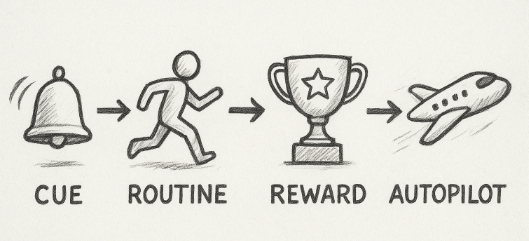
🌟 In Short:
A habit is just your brain’s way of making life easier:
👉 Cue → Routine → Reward → Autopilot.
🔄 How to Break a Bad Habit
Let’s build on the same Cue → Routine → Reward model, but this time explain how to break bad habits and build good ones in easy steps.
1. Find the Cue (Trigger)
- Ask: “What makes me do this?”
- Example: You bite nails when stressed, or scroll your phone when bored.
2. Swap the Routine
- You can’t just “delete” a habit — the brain doesn’t work that way.
- But you can replace the action with something healthier.
- Example: Instead of scrolling → go for a quick walk. Instead of biting nails → squeeze a stress ball.
3. Keep the Reward
- Your brain still needs a reward (relaxation, comfort, pleasure).
- Find a substitute reward: deep breathing, listening to music, or talking to a friend.
🌱 How to Build a Good Habit
1. Make the Cue Obvious
- Put workout clothes on your chair, keep fruits visible, set reminders.
2. Make the Routine Easy
- Start small. Do 2 push-ups instead of 20. Read 1 page instead of 10.
- The brain likes success, so small wins matter.
3. Make the Reward Immediate
- Reward yourself right away: tick a checklist, sip tea after exercise, smile in the mirror.
- Dopamine rises when the brain sees quick payoff.
✨ The Formula
- Bad Habit → Don’t fight it. Replace it.
- Good Habit → Start tiny, reward often, repeat daily.
🌟 In short:
Your habits shape you. But you can also shape your habits.
🧠 The Two Friends Inside Your Brain
Imagine inside your head live two friends:
1. Ramu – the Routine Lover
- Ramu is practical. He likes to save energy.
- He says: “Why waste brainpower on brushing teeth or tying shoelaces? I’ll automate it for you.”
- Every time you repeat something, Ramu notes it down in his little diary (that’s your basal ganglia).
- Soon, you don’t even think — your hands just do it. That’s how habits form.
2. Shyamu – the Explorer
- Shyamu gets restless. He craves new things, surprises, and challenges.
- He whispers: “Come on, let’s try a new café, a new book, a new way of doing things.”
- Shyamu runs on dopamine — the excitement chemical that lights up when something fresh or unexpected happens.
🌗 The Balance
- Ramu keeps life stable with habits (so you don’t forget how to eat, drive, or walk).
- Shyamu keeps life exciting by pushing you out of boredom.
- Too much Ramu → life feels dull and robotic.
- Too much Shyamu → life feels chaotic, always chasing thrills.
- Together, they make sure you have both stability and growth.
🌸 The Takeaway
Your brain needs habits to save energy and stay safe.
But it also needs novelty to stay alive, curious, and growing.
So if you feel bored — it’s not failure. It’s Shyamu saying: “Hey, let’s wake up and try something new!”
🧠 Boredom – Why the Brain Gets Bored with Routine
- Survival Evolution
- Our ancestors had to explore and find new food, water, and safe places.
- The brain evolved to reward novelty with dopamine → pushing humans to keep discovering.
- Learning & Growth
- Novelty activates the hippocampus (memory) and prefrontal cortex (focus).
- Repetition dulls this activation → the brain reduces attention → boredom sets in.
So boredom is actually a signal: “You’re not learning or growing here — try something new.”
👥 Why Some People Enjoy Routine While Others Don’t
1. Brain Chemistry (Dopamine Sensitivity)
- People with high dopamine sensitivity → crave variety, stimulation, challenge. They get bored fast.
- People with lower dopamine drive → feel calmer with predictability. Routine feels safe and rewarding.
2. Personality Differences
- High novelty-seekers (explorers): curious, adventurous, often creative. They thrive on change.
- Low novelty-seekers (stabilizers): grounded, patient, consistent. They thrive on stability.
- Both are valuable — one brings innovation, the other brings reliability.
3. Cultural & Upbringing Factors
- Some families and cultures prize routine (discipline, order), shaping comfort with repetition.
- Others encourage exploration (travel, new hobbies), shaping excitement for change.
4. Emotional State
- In times of stress or trauma, routine feels soothing and protective.
- In times of safety and comfort, novelty feels exciting and desirable.
🌸 The Core Truth
- The brain is wired with both forces:
- Stability (habits, routines → basal ganglia).
- Growth (novelty, curiosity → dopamine + prefrontal cortex).
- Each person’s balance between the two depends on their brain chemistry, personality, culture, and life situation.
That’s why:
- Some people love doing yoga at the same time daily.
- Others can’t stand repetition and keep switching hobbies.
Both are natural — just different settings of the same brain wiring.
💬 Are you more of a routine lover or an explorer? Share your style in the comments — let’s discover how different brains work!
Ready to reshape your habits? Start small today — your brain is always listening.
Read our blogs on holistic health here.
Some external links.