
Table of Contents
🧘 Shikha’s Story
Shikha, a busy professional, often felt like she was running a race she hadn’t signed up for. Constant deadlines, endless screen time, and sleepless nights left her anxious and drained. Even her weekends didn’t bring rest—her mind just wouldn’t slow down.
One day, she heard of some yoga sessions in her office on International Yoga Day. The yoga teacher introduced her to pranayama—the yogic art of conscious breathing. “Just the breath?” Shikha thought skeptically. But what started as an experiment slowly turned into her path to calmness, balance, and renewed energy.
🧠 Step 1: Understanding the Nervous System (SNS vs PNS)
How the Nervous System is Divided:
- Central Nervous System (CNS)
- Made of the brain and spinal cord.
- It’s the control center of the body.
- Peripheral Nervous System (PNS)
- All the nerves that branch out from the spinal cord to the rest of the body.
- Within this, we have:
- Somatic Nervous System → controls voluntary movements (like walking, typing).
- Autonomic Nervous System (ANS) → controls involuntary functions (like heartbeat, breathing, digestion).
⚡ Autonomic Nervous System (ANS) → 2 Parts
The ANS is what we are talking about when we say SNS and PNS:
SNS and PNS are two overlapping networks of nerves spread throughout the body.
- Both SNS and PNS nerves branch out from the spinal cord but connect to different organs.
- Example:
- SNS fibers come mainly from the middle part of the spinal cord.
- PNS fibers come mainly from the brainstem and the lower spinal cord.
Key SNS Nerves:
- Sympathetic cardiac nerves → speed up heart rate.
- Sympathetic fibers to lungs → widen airways for more oxygen.
- Splanchnic nerves → affect abdominal organs (stomach, liver, intestines).
- Sympathetic nerves to adrenal medulla → trigger adrenaline release.
Key PNS Nerves:
- Vagus Nerve (Cranial Nerve X) → the most important!
- Controls heart (slows rate), lungs (slows breathing), digestion, kidneys, pancreas.
- Oculomotor Nerve (Cranial Nerve III) → controls eye muscles and pupil constriction.
- Facial Nerve (Cranial Nerve VII) → controls salivary and tear glands.
- Glossopharyngeal Nerve (Cranial Nerve IX) → helps with swallowing and saliva.
- Pelvic Splanchnic Nerves (from sacral spinal cord) → regulate bladder, intestines, and reproductive organs.
Think of them like two different “wiring systems” running through the same body, always working in balance.
The Yoga teacher explained:
- Sympathetic Nervous System (SNS) → The body’s accelerator, triggering fight-or-flight. It keeps us alert but also restless if always “on.”
- Parasympathetic Nervous System (PNS) → The body’s brake, bringing rest-and-digest. It heals, restores, and calms.
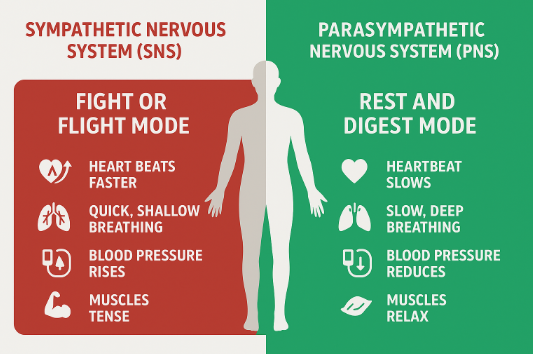
⚡ Sympathetic Nervous System (SNS) – “Fight or Flight Mode”
The SNS is like your body’s alarm system. When SNS is active, your body prepares for quick action. It releases hormones like:
- Adrenaline (Epinephrine) – from adrenal glands → increases heart rate, blood pressure, and energy.
- Noradrenaline (Norepinephrine) – from nerve endings → sharpens alertness, sends blood to muscles.
- Cortisol (stress hormone, via HPA axis) – raises blood sugar, reduces digestion, weakens immunity if chronic.
- Neurotransmitter: Mainly norepinephrine.
What happens when SNS is active?
- Heart beats faster ❤️
- Breathing becomes quick and shallow 😮💨
- Blood pressure rises 🔺
- Muscles get tense 💪
- Digestion slows down 🍽️🚫
👉 This is useful in emergencies (like running from danger), but if the SNS stays active all the time (due to modern stress, deadlines, worries), it causes:
- Anxiety and restlessness
- High blood pressure
- Poor digestion and acidity
- Insomnia
- Weaker immunity
🌿 Parasympathetic Nervous System (PNS) – “Rest and Digest Mode”
The PNS is like your body’s healing system. It mainly releases hormones like:
- Acetylcholine (ACh) – the key calming neurotransmitter.
- Slows heart rate.
- Improves digestion and absorption.
- Relaxes muscles.
- Supports memory and learning.
- Nitric Oxide (NO) – helps widen blood vessels and improves blood flow.
What happens when PNS is active?
- Heartbeat slows down 🫀
- Breathing becomes slow and deep 🌬️
- Blood pressure reduces 🟢
- Digestion improves 🥗
- Muscles relax 🛌
- Mind feels peaceful 🧘
👉 A strong PNS leads to:
- Better sleep
- Healthy digestion
- Balanced blood pressure
- More energy and focus
- Stronger immunity
- Emotional stability
🌬️ Where Pranayama Helps
Most people today are “stuck” in SNS overdrive (stress mode).
Pranayama, AUM chanting, and meditation activate the PNS, helping the body return to balance.
In simple terms:
- Too much SNS = disease, tension, burnout.
- Balanced SNS + PNS = health, energy, and peace.
Shikha realized she was stuck in SNS overdrive, which explained her racing thoughts, shallow breath, and sleepless nights. Pranayama, her teacher said, was the switch to rebalance both systems.
⚖️ In health → SNS and PNS balance each other.
🚨 In stress → SNS dominates.
🌿 In relaxation (yoga, pranayama, meditation) → PNS takes over.
Best Time for Pranayama
- Early morning (Brahma Muhurta, around 4:30–6:00 am) is considered the most powerful time — the air is fresh, the mind is calm, and the stomach is empty.
- If morning isn’t possible, late evening (sunset, after 2–3 hours of a light meal) is the next best option.
🌿 Step 2: First Encounter – Finding Balance with Anulom Vilom
Shikha’s first practice was Anulom Vilom (alternate nostril breathing).
She sat quietly, inhaled through one nostril, exhaled through the other, and repeated. Slowly, her breath deepened, and her mind became lighter.
- Effect on her body: Heartbeat slowed, thoughts calmed.
- Benefit: Balanced SNS & PNS, reduced anxiety.
“This feels like pressing the reset button,” she thought.
🔥 Step 3: Boosting Energy with Kapalabhati & Bhastrika
On mornings when Shikha felt dull and foggy, her teacher introduced her to Kapalabhati (rapid cleansing breath) and Bhastrika (bellows breath).
At first, she giggled at the forceful breathing, but soon she felt heat rising in her body, her mind becoming sharper, and her lungs expanding with new strength.
- Effect on her body: SNS activated briefly → metabolism boosted.
- Benefit: More energy, detoxification, better digestion.
Now, instead of extra coffee, Shikha had a natural energy shot.
🌙 Step 4: Calming with Chandra Bhedana & Bhramari
After hectic workdays, Shikha turned to Chandra Bhedana (left nostril breathing) and Bhramari (humming bee breath).
The gentle hum of Bhramari filled her head with soothing vibrations, washing away the noise of the day.
- Effect on her body: Vagus nerve stimulated → PNS activated.
- Benefit: Lowered stress, better sleep, reduced anger.
Her insomnia slowly faded. She started waking up refreshed.
Learn Chandra Bhedana Asana here.
🌊 Step 5: Cooling with Sheetali & Sheetkari
During summer, when heat and irritability rose, Shikha practiced Sheetali (cooling breath through rolled tongue) and Sheetkari (hissing breath through teeth).
- Effect on her body: Temperature lowered, calmness restored.
- Benefit: Controlled acidity, reduced anger, balanced blood pressure.
🕉️ Step 6: Discovering the Power of AUM
One day, her teacher asked her to end her session with AUM chanting. Shikha inhaled deeply, and as she exhaled “A-U-M,” the vibrations traveled through her chest, throat, and head. She felt grounded, connected, and peaceful.
- Effect on her body: Long exhalation → PNS dominance.
- Benefit: Deep relaxation, emotional stability, inner clarity.
It became her favorite ritual—like coming home to herself.
🌸 What is AUM (OM)?
AUM (or OM) is one of the oldest sounds in the world. In yoga, it is called the sound of the universe. When we chant AUM, our whole body feels the vibration, like a gentle inner massage.
It has 3 parts:
- A – the sound from the throat (like “aaa”), linked to our waking state.
- U – the sound rolling in the middle of the mouth (like “ooo”), linked to our dream state.
- M – the humming sound from the lips (like “mmm”), linked to deep sleep.
- The silence after AUM is the state of peace.
🌬️ Benefits of AUM Chanting
🧘 Mind
- Calms stress and anxiety.
- Makes the mind quiet and focused.
- Helps you sleep better.
❤️ Body
- The humming “Mmmm” relaxes the nerves.
- Slows down heartbeat and reduces blood pressure.
- Improves breathing and lung strength.
🌿 Inner Peace
- Increases positive energy.
- Helps in meditation and mindfulness.
- Gives a feeling of peace, balance, and connection.
👉 Just sit comfortably, close your eyes, take a deep breath, and chant AUM slowly 5–7 times. You’ll feel lighter, calmer, and more centered.
🌍 Scientific Backing Shikha Found
Curious, Shikha researched and found that studies show pranayama:
- Lowers blood pressure & cortisol.
- Improves sleep quality and mental health.
- Enhances heart rate variability (HRV)—a marker of nervous system balance.
- Boosts lung capacity and immune function.
She smiled—ancient wisdom now had modern proof.
📅 Shikha’s Weekly Pranayama Routine
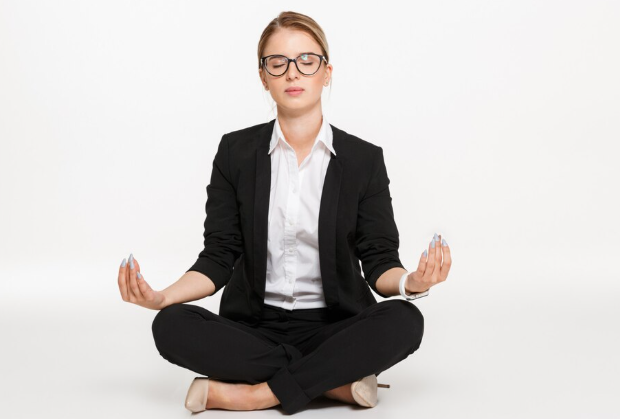
Here’s the routine she followed:
- Mon/Wed/Sat → Energizing: Kapalabhati, Bhastrika, Surya Bhedana + AUM (5 min)
- Tue/Thu → Balancing: Anulom Vilom, Nadi Shodhana, Ujjayi + AUM (10 min)
- Fri → Advanced: Mixed practices + Murchha + AUM (10 min)
- Sun → Healing: Chandra Bhedana, Bhramari, Sheetali + long AUM chanting (15 min)
✨ Shikha’s Transformation
Weeks later, Shikha noticed the changes:
- She was calmer at work, even under pressure.
- Her sleep improved, and morning headaches disappeared.
- She felt more energized without depending on caffeine.
- Most importantly, she learned how to control stress—with her own breath.
🌟 Conclusion
Pranayama is more than a breathing exercise—it’s a science of nervous system balance, a therapy for stress, and a path to inner peace.
Just like Shikha, we can all find healing and clarity through conscious breathing. Ten minutes a day is all it takes to transform stress into calm, fatigue into energy, and restlessness into peace.
So the next time life feels overwhelming, pause… close your eyes… inhale deeply… and let your breath be your guide. 🕉️
🚀 Take Your First Step Today
Like Shikha, you don’t need hours of practice—just 5 to 10 minutes daily can make a noticeable difference. Start simple:
- Day 1: Try 5 minutes of Anulom Vilom.
- Day 2: Add 5 rounds of AUM chanting.
- Day 3 onwards: Slowly explore other pranayamas.
✨ Within a week, you’ll begin to feel calmer, sleep better, and carry more energy into your day.
👉 Ready to experience it yourself?
- Start your 7-day Pranayama challenge today—set aside just 10 minutes each morning.
- Notice the shift in your mind, body, and emotions.
- Share your journey with friends or family—invite them to join and breathe better together.
Remember: Your breath is your most powerful healer. All you have to do is use it. 🌬️🧘
Types of Pranayama & Benefits
1. Anulom Vilom (Alternate Nostril Breathing)
- How: Breathe in through one nostril, out through the other, alternate.
- Benefits: Balances left (Ida) & right (Pingala) energies, calms mind, reduces anxiety, improves focus, balances SNS & PNS.
2. Nadi Shodhana (Channel Purification)
- How: Similar to Anulom Vilom but with breath retention (kumbhaka).
- Benefits: Cleanses energy channels, improves concentration, reduces stress, stabilizes emotions.
3. Kapalabhati (Skull Shining Breath)
- How: Forceful exhalations, passive inhalations.
- Benefits: Detoxifies lungs, improves digestion, energizes body, reduces belly fat, increases oxygenation, boosts metabolism.
4. Bhastrika (Bellows Breath)
- How: Forceful inhalation + forceful exhalation, like pumping bellows.
- Benefits: Increases lung capacity, energizes body, improves circulation, clears nasal passages, reduces lethargy.
5. Bhramari (Humming Bee Breath)
- How: Inhale deeply, exhale with humming sound like a bee.
- Benefits: Reduces anger, stress, anxiety, insomnia, improves voice quality, stimulates vagus nerve → activates PNS.
6. Ujjayi (Victorious Breath / Ocean Breath)
- How: Constrict throat slightly while inhaling/exhaling through nose, producing ocean-like sound.
- Benefits: Calms mind, increases oxygenation, improves concentration, helpful in thyroid issues.
7. Sheetali (Cooling Breath)
- How: Inhale through rolled tongue, exhale through nose.
- Benefits: Reduces body heat, calms thirst & hunger, good for hypertension, acidity, and stress.
8. Sheetkari (Hissing Breath)
- How: Inhale through clenched teeth (hissing sound), exhale through nose.
- Benefits: Same as Sheetali – cooling effect, calms nervous system, improves oral health.
9. Surya Bhedana (Right Nostril Breathing)
- How: Inhale only from right nostril, exhale from left.
- Benefits: Activates Pingala (solar energy), energizes body, increases heat, improves digestion.
10. Chandra Bhedana (Left Nostril Breathing)
- How: Inhale only from left nostril, exhale from right.
- Benefits: Activates Ida (lunar energy), calms mind, reduces blood pressure, induces sleep.
11. Murchha Pranayama (Swooning Breath)
- How: Deep inhalation, hold breath, exhale slowly with focus on third eye.
- Benefits: Creates sense of deep relaxation, expansion of consciousness, relieves mental tension.
Summary – Matching Pranayama to Benefits
- Stress, anxiety, sleep issues → Anulom Vilom, Nadi Shodhana, Bhramari, Chandra Bhedana
- Energy & metabolism boost → Kapalabhati, Bhastrika, Surya Bhedana
- Cooling & high BP → Sheetali, Sheetkari, Chandra Bhedana
- Focus & meditation → Ujjayi, Murchha, Nadi Shodhana
- Detox & digestion → Kapalabhati, Plavini, Bhastrika
⚠️ Note:
- Practice on an empty stomach, preferably early morning.
- People with heart problems, high BP, pregnancy, or medical conditions should practice under guidance.
Further Reading
For scientific evidence on pranayama’s impact on the nervous system and health:
Effect of Pranayama on Stress and Cardiovascular Health – National Library of Medicine.
Common Yoga Protocol — Ministry of External Affairs, Government of India
This official booklet outlines pranayama techniques like Anulom Vilom (alternate nostril breathing) and Bhramari as essential components of yoga for holistic health. MEA India
Read more blogs on Yoga & holistic health here.